🚚 Free Worldwide Shipping on All Orders!Shop Now

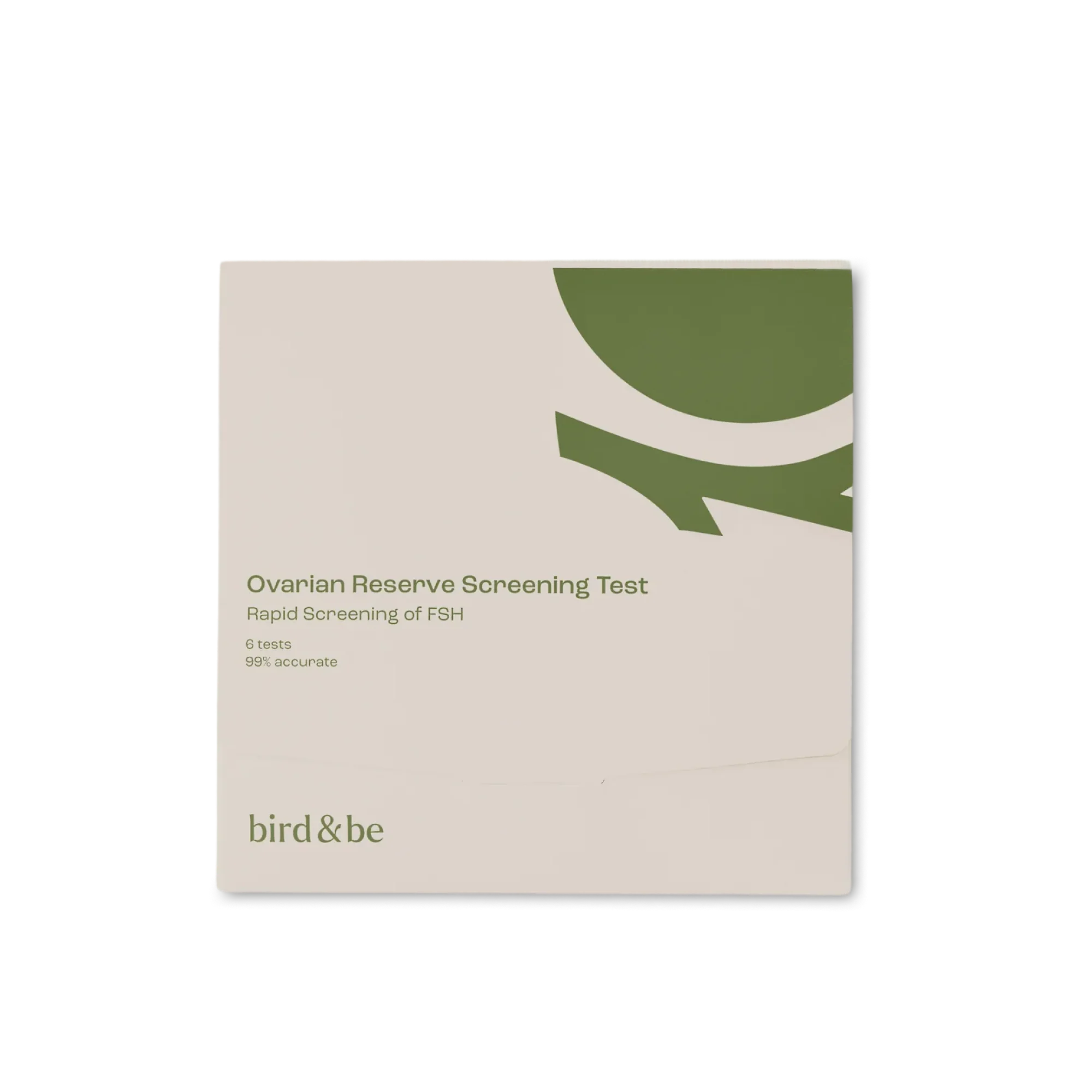
Bird&Be - Ovarian Reserve Screening Test, 6 Count
Curious about your egg quantity? Our at-home strips test the FSH (follicle-stimulating hormone) in your urine, which is one of the markers of ovarian reserve. It’s a valuable insight to support your fertility planning—and, if needed, to empower you to speak to a doctor sooner for further diagnostic testing.
Follicle-stimulating hormone (FSH) is released by the pituitary gland and stimulates follicle development in the ovaries, crucial for ovulation. As our ovaries age, they contain fewer eggs and also become less responsive to this FSH stimulation. To compensate for the “resistant” ovaries, our body releases more FSH to try to get the ovaries to recruit, develop and mature follicles in order to ovulate. So higher FSH might mean less eggs in your ovaries.
This is just one of the markers of diminished ovarian reserve, and it doesn’t speak to egg quality. A high FSH level doesn’t mean you can’t conceive and a low FSH doesn’t guarantee you’ll conceive easily. But understanding your FSH levels can be an empowering piece of info to help guide your next steps, including when to see a doctor if you’re trying to get pregnant or making plans.
$36.56
Bird&Be - Ovarian Reserve Screening Test, 6 Count—
$36.56
Bird&Be - Ovarian Reserve Screening Test, 6 Count
Curious about your egg quantity? Our at-home strips test the FSH (follicle-stimulating hormone) in your urine, which is one of the markers of ovarian reserve. It’s a valuable insight to support your fertility planning—and, if needed, to empower you to speak to a doctor sooner for further diagnostic testing.
Follicle-stimulating hormone (FSH) is released by the pituitary gland and stimulates follicle development in the ovaries, crucial for ovulation. As our ovaries age, they contain fewer eggs and also become less responsive to this FSH stimulation. To compensate for the “resistant” ovaries, our body releases more FSH to try to get the ovaries to recruit, develop and mature follicles in order to ovulate. So higher FSH might mean less eggs in your ovaries.
This is just one of the markers of diminished ovarian reserve, and it doesn’t speak to egg quality. A high FSH level doesn’t mean you can’t conceive and a low FSH doesn’t guarantee you’ll conceive easily. But understanding your FSH levels can be an empowering piece of info to help guide your next steps, including when to see a doctor if you’re trying to get pregnant or making plans.
Product Information
Product Information
Shipping & Returns
Shipping & Returns
Description
Curious about your egg quantity? Our at-home strips test the FSH (follicle-stimulating hormone) in your urine, which is one of the markers of ovarian reserve. It’s a valuable insight to support your fertility planning—and, if needed, to empower you to speak to a doctor sooner for further diagnostic testing.
Follicle-stimulating hormone (FSH) is released by the pituitary gland and stimulates follicle development in the ovaries, crucial for ovulation. As our ovaries age, they contain fewer eggs and also become less responsive to this FSH stimulation. To compensate for the “resistant” ovaries, our body releases more FSH to try to get the ovaries to recruit, develop and mature follicles in order to ovulate. So higher FSH might mean less eggs in your ovaries.
This is just one of the markers of diminished ovarian reserve, and it doesn’t speak to egg quality. A high FSH level doesn’t mean you can’t conceive and a low FSH doesn’t guarantee you’ll conceive easily. But understanding your FSH levels can be an empowering piece of info to help guide your next steps, including when to see a doctor if you’re trying to get pregnant or making plans.